



 About St. Elizabeth of Hungary
St. Elizabeth is remembered for her charitable works, especially for the establishment of hospitals. Today, dozens of hospitals and medical centers are named for her. Several of them were founded by the Sisters of St. Francis. Elizabeth lived at a time when the combined disasters of climate, war, pestilence, and poverty caused great suffering, and she became devoted to helping those who had nowhere to turn.
Elizabeth was born in Hungary in 1207. Her short but fruitful life lasted 24 years. She passed away in Marburg, Germany on November 17, 1231, thus, the Church celebrates the feast day of St. Elizabeth on November 17th.
She began life as part of the Hungarian nobility, daughter of King Andrew II. At age 14, she married the 21-year-old Ludwig IV of Thuringia (Germany). He was appointed regent of Meissen and the East Mark and soon became employed by Holy Roman Emperor Frederick II as a soldier and diplomat.
Since childhood, Elizabeth was deeply religious, and Ludwig supported her in this, including her acts of charity. While he was away for missions under Frederick II, Elizabeth took charge of local affairs and distributed alms in all parts of her husband's territory. A well-known painting depicts her personal involvement in charitable works.
Elizabeth's life was consumed deeply by her devotion to God and her charitable labor. She passed away at the age of 24, on November 17, 1231, in Marburg, Hesse.
 One of her greatest known miracles occurred when she was still alive, the miracle of roses. It is said that during one of her many trips delivering bread to the poor in secret, Ludwig met with her and asked her questions to erase everyone's suspicions that she was stealing treasures from the castle. He asked her to reveal the contents under her cloak, and as she did a vision of white and red roses was seen. To Ludwig, this meant God's protection was evident. In other versions, it was her brother-in-law who found her. Elizabeth's story is one of the first of many that associates Christian saints with roses. Elizabeth's body was laid in a gold shrine in the Elisabeth Church in Marburg. Although the shrine can still be seen today, her body is no longer there. One of her own descendants scattered her remains at the time of the Reformation.
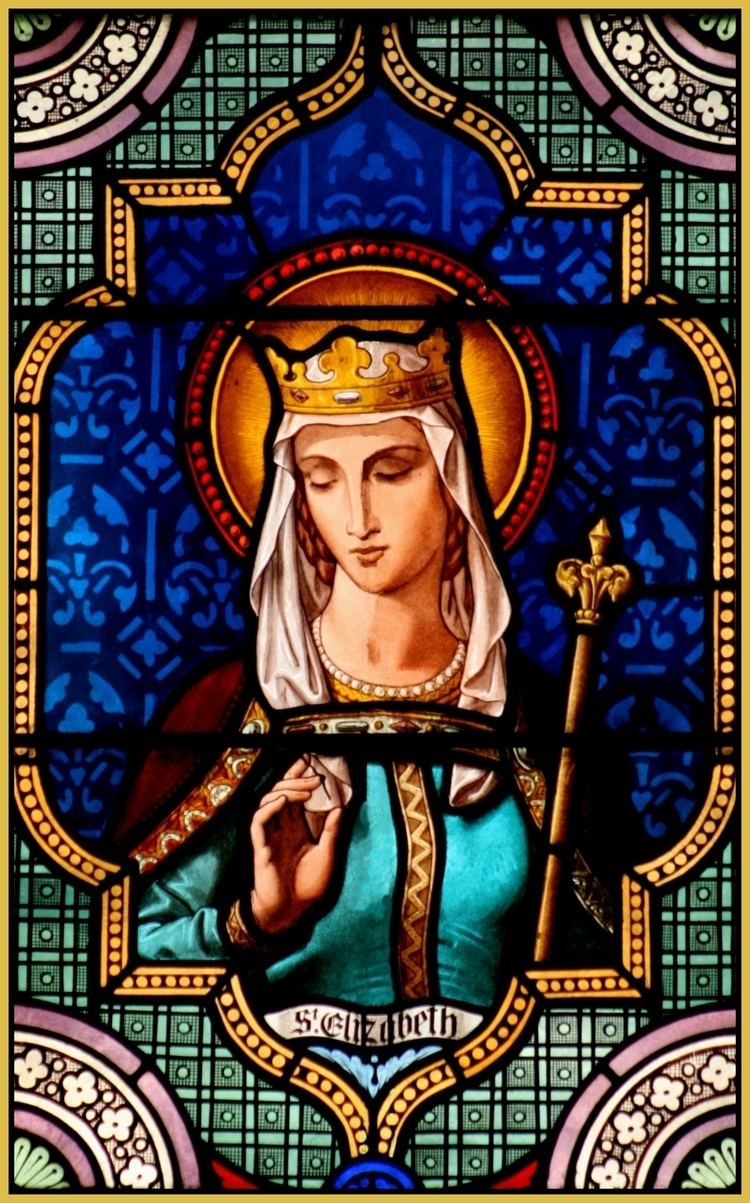
St. Elizabeth is often depicted with a basket of bread to show her devotion for the poor and hungry. She is also painted in honor of the "Miracle of Roses" and "Crucifix in the Bed."
St. Elizabeth has been praised by Pope Benedict XVI as a "model for those in authority."
A Prayer To St. Elizabeth
Almighty God, by whose grace your servant Elizabeth of Hungary recognized and honored Jesus in the poor of this world: Grant that we, following her example, may with love and gladness serve those in any need or trouble. In the name, and for the sake of, and through Jesus Christ our Lord, who lives and reigns with you and the Holy Spirit, one God, now and forever. Amen